Showing posts with label 1930s. Show all posts

Wednesday, 19 February 2025

Sirk in Germany (1934 - 1935)


Eureka Entertainment are bringing out a double disc set of German director Douglas Sirk's early works that includes three feature films and some short pieces, all in new restorations from the Friedrich Wilhelm Murnau Foundation. Sirk is best known for a series of vividly colourful melodramas he made in Hollywood in the 1950s. While in this set Sirk is very much at the beginning of his career, all three films are eminently watchable (and are actually immensely entertaining). They also require no prior familiarity with the director's work in order to appreciate them. 


Disc One


April, April! (1935)


That's the German for 'April Fool!' by the way. Sirk's directorial feature debut is an 82 minute comedy of mistaken identities. The owner of a pasta company receives a message that a prince is interested in his product. It's April Fool's Day and two of the pasta owner's friends decide to play a trick and convince him and his stuck up family that the prince is coming to visit the factory. Things start to get out of hand when the story is leaked to the papers, necessitating someone to actually play the prince. Then the real prince reads the news story and turns up to the factory as well. Much hilarity ensues in this pacy, good-natured, thoroughly entertaining piece of classic comedy that breezes along in the presence of likeable characters acted well.


The film comes with a commentary track by Sirk expert David Melville Grove who provides an erudite and extremely listenable commentary track that frequently goes into detail about what's happening on screen.


The disc also include three short comedy pieces: TWO GREYHOUNDS (30 minutes) in which applicants for an accountant's job end up in a case of mistaken identity; THREE TIMES BEFORE (19 minutes silent with intertitles, 16 minutes silent but with subtitles) is a story of marital disharmony that results in intervention by a third party; and THE IMAGINARY INVALID (38 minutes), an adaptation of a play by Moliere.


Disc Two


The Girl From Marsh Croft (1935)


The girl in question is Helga, a maid who has had a child by her previous employer and now cannot find work in the small rural German town on which the film is set. Kind-hearted Karsten takes pity on her and offers her a job on his farm, much to the consternation of his fiancĂ© Gertrud, who demands Helga be dismissed from his service. 


A romantic melodrama, THE GIRL FROM MARSH CROFT also provides a fascinating historical insight into the farming activities of the rural folk of Germany in the 1930s. There's also a bit of magic realism in there if you want it. Eureka's presentation is aided immensely by a very helpful commentary track by David Melville Grove who frequently analyses scenes with particular attention to why director Sirk has chosen particular camera angles and movements. He points out the (to this viewer) almost godlike character of Jens the boatman, instead likening him to a Greek chorus, whic is also an apt description. Like APRIL! APRIL! the film holds up surprisingly well and, like that film, tells its tale in a brisk 81 minutes. 


Pillars of Society (1935)


A Henrik Ibsen play is the basis for this tale of a wealthy shipbuilder whose empire turns out to have been based on lies and deceit. In fact so cynical is this film in places it's rather depressing to say that it doesn't feel that dated. Albrecht Schoenhals, who played the prince in APRIL! APRIL! returns here as the Norwegian brother-in-law done wrong by Heinrich George's corpulent man of business who also has a secret love child. The climax is set during a well-executed (for 1935) storm at sea and the entire enterprise demonstrates Sirk's developing feel for both melodrama and character development. 


Disc two also has a 20 minute piece from Sheldon Hall who offers a useful potted history of Sirk's life and career, explaining how over the years the director's work has come to be more appreciated through film texts and retrospectives, as well as paying special attention to the three films included in this set. 


Finally, the set comes with a limited edition 'O' card and a collector's booklet featuring new writing on the films. 


Sirk in Germany is out from Eureka Entertainment in a limited edition (of 2000) double disc Blu-ray set on 

Monday 24th February 2025

Friday, 14 April 2023

Creeping Horror (1933 - 1946)


Eureka continue their excellent work releasing classic Universal horror movies to Blu-ray and making them available to UK buyers with new and different commentary tracks to their US Shout Factory counterparts. This time round we get four films, so let's take a look at what's on the set:


Murders in the Zoo (1933)


A cracking example of early 1930s pre-code pulp horror, here we have Lionel Atwill as a big game collector whose wife, played by Kathleen Burke, only has to so much as look at another man for the unfortunate fellow to meet a horrible fate. Of course with this being pre-code, it's quite possible that Burke's character has been doing more than just looking at other men and may have driven poor old Lionel to his current state of homicidal insanity. 


He delivers his latest shipload of animals to an American zoo, and bumps off Kathleen's latest lover at a charity dinner using green mamba venom. But Kathleen is soon onto him and so the bodies have to start piling up. At just over an hour MURDERS IN THE ZOO is brisk murder-filled fun with Atwill stealing every scene he's in (of course). 

Eureka's print is slightly cut (by Eureka themselves apparently) for animal cruelty. Extras include an image gallery and a commentary track from the always reliable Kevin Lyons and Jonathan Rigby.


Horror Island (1941)


A cracking title for a so-so film and the least of this particular set (partly because all the others range from excellent to extremely watchable). Originally double-billed with MAN MADE MONSTER, HORROR ISLAND is more of a mystery romp than a horror picture. Wooden-legged (just the one, mind) Tobias Clump (Leo Carrillo) owns one half of a treasure map. The other half has been stolen by a mysterious character known only as the Phantom. Soon we have Dick Foran, Peggy Moran and a bunch of others all travelling to an isolated pirate castle where shenanigans ensue. HORROR ISLAND has been bundled in with several 'Universal Horrors' sets over the years but it always feel like the sore thumb of the bunch, as it does here. Commentary duties are again essayed by Kevin Lyons and Jonatan Rigby, who are much nicer to the movie that I have been here, and there's a still gallery. 


Night Monster (1942)


A 'B' movie programmer (the original 'A' was Universal's THE MUMMY'S TOMB, which is nowhere near as good a this) NIGHT MONSTER is a variation on the theme of a group of people being bumped off in an isolated country house location. But it's also rather weird, boasting a mix of mysticism and monsters combined with an excellent cast (Bela Lugosi, Lionel Atwill, Ralph Morgan, Nils Asther and Leif Erickson) and a plot that must have had audiences opened-mouthed at the explanation for it all back in the day. I'm not going to say any more about the plot because that would be spoiling it, but NIGHT MONSTER might just be the best film on this particular set. 


Eureka's disc boasts a brand new commentary track by Kim Newman and Stephen Jones who are as enthusiastic as I am for this one, pointing out its unique properties, giving us some good background on director Ford Beebe, and I agree with Mr Jones that Janet Shaw should have had a lot more screen time in a lot more movies.


House of Horrors (1946)


The run of 'classic' Universal monster movies was close to its end by the time they made HOUSE OF HORRORS. Martin Kosleck (the real star of this one even though he's billed quite a way down the list) is impoverished sculptor Marcel DeLange, who receives sufficient bad notices for his work that he decides to drown himself. On the point of doing so he sees someone crawling out of the river. It's The Creeper (Rondo Hatton) whose acromegalic features inspire not just to stay alive but to sculpt again, with The Creeper as the subject. He also gives his new subject a home, but while DeLange sleeps The Creeper prowls, randomly murdering a prostitute before bumping off the critics who had given his new friend bad notices.


HOUSE OF HORRORS does feel a bit like a studio at the end of its inspiration, but it's still an entertaining piece of work, especially for fans. Kosleck is excellent but Hatton is not a great actor, and Universal's attempts to turn The Creeper into a series were not successful, with only one, the prequel THE BRUTE MAN being filmed. 

Eureka's extra for HOUSE OF HORRORS is a new commentary from Stephen Jones & Kim Newman who give the film (and its director, Jean Yarbrough) the enthusiastic appreciation it deserves. There's also a lengthier image gallery than for the other movies.


Creeping Unknown is coming out as a two disc Blu-ray set from Eureka on Monday 17th April 2023. 

Sunday, 27 November 2022

The Cat and the Canary (1939) and The Ghost Breakers (1940)


Eureka are bringing out two classic comedy horror pictures from Paramount, both starring Bob Hope and Paulette Goddard with THE GHOST BREAKERS being presented from a new 2K master. Here's what we get:


The Cat and the Canary (1939)


The 1939 feature version of this well-known stage play sets its 'Midnight Will Reading in an Old Dark House' plot in the depths of the Louisiana swamps. Hope, Goddard and a motley assortment of family members gather to hear George Zucco's solicitor explaining that everything goes to Goddard's character providing she stays alive and sane. But what's that? A psychopathic killer called The Cat has escaped from the local mental institution and may be headed their way? And there's a hidden necklace worth thousands hidden on the property too?


With all of this going on it's surprising to realise that director Elliott Nugent gets everything done and dusted in 72 minutes (the 1927 Paul Leni silent version is closer to two hours). It's a crisp affair with crackling dialogue and appealing leads. The film's secret weapon, though, is Gale Sondergaard as the creepy housekeeper, obviously relishing every line of dialogue she has. 


Extras consist of a commentary track from Kevin Lyons and Jonathan Rigby who have plenty to tell us about the cast , the production, and the history of the play and its various adaptations, including that the two earlier Universal sound versions are now considered lost films. While they do point out that the alligators we see have their jaws taped shut they don't spot that Paulette Goddard goes to bed with her shoes on. Kim Newman provides an excellent 20 minute summation of the 'source novel' of this subgenre, Earl Derr Biggers' Seven Keys to Baldpate, and the productions it inspired, and there's also a trailer.


The Ghost Breakers (1940)


While THE CAT AND THE CANARY wastes no time getting its protagonists out to its scary location, THE GHOST BREAKERS has more breathing space to set up its characters. This time Hope is Lawrence Lawrence Lawrence ("My parents didn't have much imagination") a radio personality and 'Ghost Breaker' which seems to involve him revealing secrets about mob bosses live on air. 


At least, that's what causes him to end up in Paulette Goddard's trunk bound for her haunted ancestral Cuban castle (a fantastic set, by the way). The cast is livened up by a young Richard Carlson and an even younger Anthony Quinn but the film almost belongs to Willie Best as Hope's manservant / sidekick. Add in Nobel Johnson as a zombie and it's certainly arguable that THE GHOST BREAKERS is even better than its predecessor.


Extras for this film consist of a 30 minute radio version (also starring Hope), a trailer, and another excellent Lyons and Rigby commentary track that provides plenty of information on the cast (including the bit players) and is extremely helpful in explaining some of the 'of its time' humour that certainly went over my head, especially all the stuff where Hope & Goddard are dancing on the boat. 


THE CAT AND THE CANARY and THE GHOST BREAKERS is out as a single disc Blu-ray set from Eureka on Monday 5th December 2002. The first 2000 copies will  also includes a collector's booklet with new writing by Craig Ian Mann, and a slipcase


Thursday, 14 July 2022

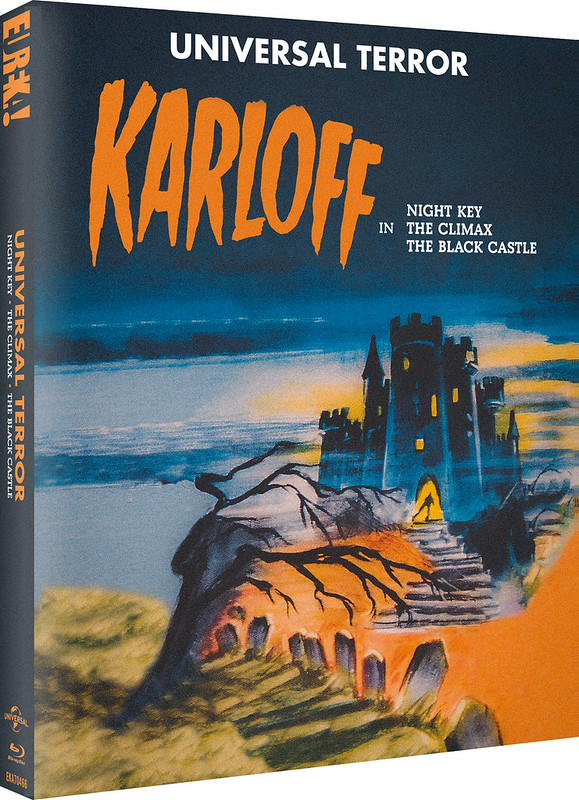
Universal Terror: Karloff In...(1937, 1944, 1952)


Following on from their sets devoted to Bela Lugosi and Karloff at Columbia, Eureka are bringing out three more movies featuring Boris Karloff. From the title and artwork you'd think you were buying a set of horror movies, but actually none of what's included here is what one might consider typical horror product of the period. That said if you're a fan of crime thrillers, swashbucklers and light opera with a sinister edge these might be just the ticket. Here's what you get:


Night Key (1937)


How NIGHT KEY came to be considered a horror film is one of the many things covered in the accompanying commentary track by Kevin Lyons and Jonathan Rigby, one which also discusses the careers of many of the actors (including pointing out bit part players!), the situation Universal was in at the time the film was made, and about how and why Universal's classic monster movies ended up being re-released by RealArt in the late 1940s and early 1950s.


As for NIGHT KEY itself, it's a very enjoyable crime melodrama in which Boris Karloff has been cheated out of the profits of a security system he's invented by (now very rich) Samuel S Hinds. But Boris has now invented a new one that threatens to supercede the old and put Hinds out of business. So Hinds swindles him again and Boris becomes 'Night Key', breaking into properties 'protected' by Hinds' old system and leaving the message 'What I Create I Can Also Destroy'. Of course it's not long before local gangsters become aware of Boris & his device and they're keen to get their hands on it. Don't go into this one expecting horror and you'll have a brisk, breezy and highly entertaining time with it. As well as the commentary the disc also includes still galleries and a trailer.


The Climax (1944)


It takes a bit of effort to get worked up over THE CLIMAX, Universal's follow-up to their sumptuous 1943 production of THE PHANTOM OF THE OPERA (the one with Claude Rains) and shot on the sets of that film to help recover some of the cost of it. On the plus side we have Boris Karloff top-lining as a doctor who has murdered his opera diva wife ten years before, keeping her body preserved in the kind of situation we'd see multiple times over in the Corman/Poe pictures of twenty years hence. When a young singer (Susanna Foster) reminds him of his dead wife, he becomes obsessed with having her sing only for him. 


On the minus side (depending on your tastes) we have a lot of singing. If you're a fan of light opera then this may be right up your street but if you're not then you'll be finding your finger straying to the fast forward button. Otherwise the Technicolor photography is glorious and we also get to see Turhan THE MUMMY'S TOMB Bey pretending to play the piano, but in the end THE CLIMAX is one for forgiving fans of the period. Messrs Lyons and Rigby return for commentary duties and turn the film into one that's more worth watching with the commentary on than off as the running time passes somewhat faster with their aid.


The Black Castle (1952)


Less a horror film and more a swashbuckling Boys' Own Adventure (as these kinds of stories used to be known), THE BLACK CASTLE gives us dashing hero Richard Greene, off to investigate the dastardly doings of an evil count in the depths of the Black Forest. Director Nathan Juran manages a nicely atmospheric opening with this one, and Joseph Gershenson makes sure there's lots of familiar Universal library music on the soundtrack. Even so, you'd be hard pushed to call this a horror film, even with the presence of Karloff as the Count's physician and a rather demeaning minor role for Lon Chaney, Jr. On the other hand if you're a fan of sword fights, panther wrestling and a pit filled with alligators this will pass the time very nicely indeed.


Stephen Jones and Kim Newman provide the commentary for this one and, like all their commentaries, not a second is wasted and at points they almost talk over each other in their enthusiasm to share as much information and opinion as possible. As with THE CLIMAX, I found THE BLACK CASTLE to be a more enjoyable watch with the commentary switched on than off so it's good to have it on here.


Universal Terror: Karloff In... is out as a two-disc Blu-ray set from Eureka on Monday 18th July 2022

Sunday, 29 May 2022

Vampyr (1932)


"Superb Package For a Uniquely Strange Film"


Carl Dreyer's strange, fascinating, highly influential vampire picture gets a 90th anniversary Blu-ray release of a 2K restoration by the Danish Film Institute (that apparently took ten years) from Eureka.


'Dreamer' (so the opening text informs us) and H P Lovecraft lookalike Allan (or David depending on the version) Gray arrives in the small French village of Courtempierre, only to become immediately involved in strange goings-on. One of the two daughters of a rich family is sick. The cause may be an old lady who is in fact a vampire and aided by a weird doctor. Reality becomes blurred as Gray becomes more involved, imagining himself being buried alive and eventually discovering the tomb of the vampire, whom he stakes with a metal spike. 


Based on not just Carmilla but apparently Carl Dreyer's response to the entire collection of Joseph Sheridan LeFanu's stories in which that novella first appeared (In a Glass Darkly), VAMPYR is a unique piece of genre film-making that, a little like the events its protagonist experiences, seems itself to exist somehow out of time. Released the year after Tod Browning's DRACULA (1931) had set the template for 'mainstream' horror. Dreyer's film is stubbornly experimental, light on both plot and action, and very much the art house piece.


Despite its poor distribution and lack of commercial success, watching it today  it's easy to see just how much many celebrated horror film-makers (especially Europeans) were influenced. One can imagine Jean Rollin viewing that narrow grandfather clock and thinking how he'd like to see a very thin vampire lady emerge from it (he also pinched the swivelling skull for his 1971 LE FRISSON DES VAMPIRES), and the cracked vampire's tomb at the end looks a lot like Dr Freudstein's at the climax of Lucio Fulci's 1981 HOUSE BY THE CEMETERY.


Eureka's disc comes packed with extras. There are two commentary tracks, one by film critic Tony Rayns and the other by film-maker Guillermo del Toro. Kim Newman has a 22 minute talking head piece in which he compares VAMPYR to Robert Eggers' THE WITCH, stating that if you're in the wrong mood when you watch these films you'll find them tedious but if you're in the right mood they'll haunt you for the rest of your life, and I'd definitely agree with him on that.


David Huckvale offers a superb and detailed breakdown of Wolfgang Zeller's music score, and Mr Huckvale is back to tell us more about In a Glass Darkly and its influence on the film. The Baron is a short film about Baron Nicolas de Gunzberg, VAMPYR's star, who essentially funded it in return for the lead role (and he's not bad at all), and Jorgen Roos' 1966 Dreyer documentary is on here too. Don't forget to watch the censored scenes, which offer more footage of the staking and of the evil doctor's climactic suffocation in the grain mill. Finally, you get a 100 page book featuring stills, interviews, and essays and the entire package is housed in a hardbound slipcase. 


The 90th Anniversary 2K Restoration of Carl Dreyer's VAMPYR is out from Eureka on Monday 30th May 2022

Thursday, 29 April 2021

Karloff At Columbia (1935 - 1942)


"An Essential Set"


Eureka are releasing a Blu-ray set of six splendid films that Boris Karloff made for Columbia Pictures in the 1930s and 1940s, consisting of THE BLACK ROOM and five mad doctor pictures. Previously this set has only been available on a Region 1 DVD set. You can now safely replace that with this, which also comes with excellent commentary tracks on every film. Here's what's on them in more detail:


Disc One


The Black Room (1935)


The earliest film in the set is a full-blooded period gothic set mainly in the early nineteenth century. Twins are born to the de Berghmann family and they both grow up to be Boris Karloff in dual roles as Gregor (the evil one) and Anton (the good one). In order to maintain control of the estate Gregor kills Anton and impersonates him, paralysed right arm and all. But the prophecy that Anton will kill Gregor in the black room of the title is yet to be fulfilled.

Terrific production design and skilful direction from Roy William Neill (Universal's FRANKENSTEIN MEETS THE WOLF MAN amongst others) combined with two fine performances from Karloff mean THE BLACK ROOM is at least the equal of some of Universal's gothics of the period, even if it's not as well known. Jonathan Rigby and Kevin Lyons provide an engaging fact-packed commentary track covering the careers of many of the actors featured, the subject of twins in cinema, Roy William Neill's fascination with ravens and much more.


The Man They Could Not Hang (1939)


Karloff is Dr Henryk Savaard, creator of an artificial heart. His first experiment on a human subject results in death not because of the device but because his nurse calls the police before the experiment is over. Sentenced to death he swears revenge on those who sent him to hang and when he's up and about again, thanks to his assistant, that's exactly what he does.


The commentary track on this one is from Stephen Jones & Kim Newman who, as is usual for them, exhibit such knowledge and enthusiasm that there's barely space on the soundtrack for both of them to get all their facts and opinions out. I especially liked that if the film had been set in California it would have had to be called THE MAN THEY COULD NOT GAS and I agree with Kim Newman that the final act deserved another fifteen minutes to fit in three more killings.


The Man With Nine Lives (1940)


After twenty minutes of set up we finally get to see Karloff - encased in ice! This time he's Dr Leon Kravaal, experimenter with cryogenics, who has frozen himself and those who doubted him in the caves beneath his creepy old isolated island home. He's defrosted but has forgotten the formula for his revolutionary treatment, which is the cue for further underground experiments. Compared to THE MAN THEY COULD NOT HANG what this one lacks in vitality it makes up for with the claustrophobia of most of the film being set in a couple of small rooms.


It had never occurred to me before, but the Newman and Jones commentary track quite rightly alludes to MAN WITH NINE LIVES feeling in the tradition of stories from the US magazine Weird Tales, with both this and its predecessor firmly in the 'shudder pulp' tradition. Their commentary this time makes for a good 'follow on' from MAN THEY COULD NOT HANG and is therefore worth listening to after that one.


Karloff on Radio


Two stories from the Inner Sanctum radio series - The Corridor of Doom and The Wailing Wall. Both are great fun to listen to, and the references to Liptons Tea (the show's sponsor) beforehand actually serve to help turn the clock back and weirdly improve the listening experience.


Disc Two


Before I Hang (1940)


Karloff is Dr John Garth (and not Gaarth despite recurring writer Karl Brown's name being once again in the credits). Sentenced to death for euthanasia he spends his remaining days  perfecting an anti-aging serum that has the side effect of turning him into strangler, and when he's unexpectedly pardoned that's exactly what he keeps on doing. Better paced that MAN WITH NINE LIVES this keeps you so enthralled you don't even realise you've been listening to five minutes of Chopin's Etude No.12 in C Minor near the end. Jonathan Rigby and Kevin Lyons provide the commentary duties on this one with plenty of detail on cast and crew, & Mr Rigby even mentions the Lindbergh cardiac pump that possibly formed the inspiration for one of the devices seen in this one.


The Devil Commands (1941)


Taking its inspiration from William Sloane's excellent Nigel Kneale-esque novel of cosmic horror The Edge of Running Water this sees Karloff's Dr Julian Blair attempting to 'pierce the veil' to see what lies beyond death after his wife is killed and he believes she is trying to contact him through his new brainwave machine. Some bland voice overs from Amanda Duff and some fumbled direction from Edward Dmytryk who gave us CAPTIVE. WILD WOMAN makes THE DEVIL COMMANDS less effective than it could have been but there's still some marvellous mad doctor stuff in this one. Stephen Jones & Kim Newman return for commentary duties, talking about the William Sloane novel on which the film is based, the career of Edward Dmytryk and lots more.


The Boogie Man Will Get You (1942)


The final film in Columbia's mad doctor series is strictly played for laughs as Karloff's mad doctor sells his house to pay off the mortgage imposed on him by the town doctor / sheriff / notary / moneylender, played by Peter Lorre. Karloff stays in the house to continue his experiments on travelling salesmen as he tries to perfect a race of supermen to help the war effort and convinces Lorre to help him. The interplay between the two stars is a delight, making up for some somewhat tired slapstick old dark house shenanigans. Your tolerance for screwball comedies of then 1940s will dictate how well you'll get on with this one. Jonathan Rigby and Kevin Lyons return to provide the final commentary track of the set.


Karloff on the Radio


Two more tales from the Inner Sanctum radio series - Birdsong for a Murderer and Death For Sale round out the second disc.


With the transfers, commentaries and assorted extras (including stills and poster galleries for each film) this is an essential set. It would be wonderful if Eureka could do the same with the Region 1 six film MGM set of years past that also included Newman and Jones commentaries on movies like Tod Browning's MARK OF THE VAMPIRE. Failing that, how about giving us a three disc set of BELA LUGOSI AT MONOGRAM?


KARLOFF AT COLUMBIA is out in a two disc Blu-ray set from Eureka on Monday 3rd May 2021