Wednesday, 8 February 2012

Inferno (1980)


It may be because of the paucity of visually imaginative genre product these days, or possibly just because I'm getting old, but as the years go by Inferno, Dario Argento's 1980 follow up to his ground-breaking nightmare on celluloid SUSPIRIA, just seems to get better and better. The film was a bit of a financial disaster on its original release - as far as I'm aware it played a week in London cinemas and then got pulled without being given a chance in the provinces. It fared even worse in the US, not getting a theatrical release at all because Fox boss at the time Sherry Lansing thought the violence too extreme. Presumably this must have been just before Paramount made history by being the first major motion picture company to release the independent blood-splattered horror extravaganza that was Sean Cunningham's FRIDAY THE 13th. 
But back to Inferno, a film with so many stunning visual images and sequences that you're almost completely distracted from the story, which according to Argento on the accompanying documentary on the Arrow Films DVD is intended to raise questions and provide no answers - in the same way an alchemist does. There's something strangely reassuring about this explanation making about as much sense as the film he's talking about. Besides, we all know by now that these films aren't meant to make sense, at least not in the conventional way. Instead we just need to sit back and let ourselves be taken through a bizarre dreamlike world filled with imagery no-one else can do quite like Argento used to be able to. 
       The underwater room sequence is still a marvel, as are the scenes in the library. The other-worldly blue and pink lighting scheme that permeates most of the scenes means we're constantly being reminded that we are not in the real world. The actors are either eccentrically interesting (Sacha Pitoeff and Feodor Chaliapin) or leading man good looking but ineffectual (Leigh McCloskey and Gabriel Lavia, with Lavia getting a knife in his throat just for being a gentleman). The actresses, on the other hand are a different matter. Eleonora Giorgi is gorgeous but amazingly is reduced to looking merely ordinary next to the scarily overbearing sexiness of Ania Pieroni. Irene Miracle looks just as good underwater as out of it and Daria Nicolodi is probably at her prettiest and most vulnerable here. Argento has freely admitted that his male characters tend to be weak, and while accusations of misogynism have been levelled at him he certainly uses INFERNO to show off his actresses to their best advantage. The music's great as well, with Argento being absolutely right to get Keith Emerson to provide music that wasn't imitative of Goblin. Mater Tenebrarum is a mini-masterpiece but Emerson's flamboyant riffs and elegant main title music are all quite splendid. 
Perhaps the greatest delight I've found with INFERNO is that even on a very recent viewing I was able to see things I hadn't noticed before. In fact the film still feels fresh even though it's over thirty years since it was made, and since then there has been little to compare with it. Like a lot of Argento's work there's not much in the way of humour on display here, which is probably just as well as when he tried to be funny it often fell flat, as evidenced in FOUR FLIES ON GREY VELVET. However, when I learned that the sequence at the end where Veronica Lazar's Mater Tenebrarum crashes through the mirror was apparently orchestrated by Mario Bava, I like to think that with that director's mischievous sense of humour Bava might have been tempted to place a bottle of B&J in the background.

Sunday, 5 February 2012

The Cheat (1931)


The release of the pre-Hays Code ‘Forbidden Hollywood’ DVD box sets has meant the chance to see some previously unheard-of gems (by me anyway) from the era before various religious and financial institutions caused the imposition of restrictions on what was deemed ‘inappropriate material’ to put on film during the 1930s and 1940s in Hollywood. The Hays Code and its effect on horror cinema is worthy of a long essay in itself but for now let’s concentrate on THE CHEAT.
Tallulah Bankhead (who I had previously seen only in Hammer’s DIE, DIE MY DARLING and while much younger here definitely comes across as someone more worldly wise, cynical and scary than her age at the time ought to have suggested) plays Elsa Carlyle, who is happily married to Jeffrey (Harvey Stephens, obviously not the one from THE OMEN) but has a problem. She’s addicted to gambling and is utterly hopeless at it. 
       Losing $10 000 one night at the turn of a card, the next day she is entrusted with the $13 000 plus that the ladies’ Milk Fund Charity (whatever that might be) has managed to raise to help starving orphans. Rather than simply use it to pay off her debt she invests $10 000 of that in something really very hopeless indeed, only finding out that she has lost everything when she is attending an orientally themed fancy dress party the following evening. There she is, on the phone, wearing a hat that’s ten times bigger than her head and about one thousand times smaller than her chances of her husband forgiving her if he finds out how much money she’s managed to lose. 
       Luckily for absolutely no-one in this film at all she has already met rich Hardy Livingstone (Irving Pichel, looking a lot healthier here than he would in a couple of years’ time as Gloria Holden’s henchman Sandor in Universal’s DRACULA’S DAUGHTER). Hardy loves all things oriental, including clothes, servants, and dolls, of which he has a collection locked in a cupboard to remind him of past lovers. He shows Tallulah these in a scene reminiscent of the pulp horror stories of the time. Each doll has been branded with his mark to show he owns them. He offers to give Tallulah a cheque to help her with her debt in return for ‘special favours’ we can all guess the nature of. Tallulah accepts the money but lo and behold lovely, unsuspecting, ever forgiving hubby has paid her debts off for her. She tries to return the cheque but Hardy’s not happy and just to prove it he burns his mark into her chest with the branding iron he has handily heating up in the brazier in his living room. Understandably upset at this Tallulah shoots him just as Jeffrey arrives to take the rap as the servants come running in.
       The rest of the movie’s short running time is taken up with the court case. Hardy has only been wounded and tries to discredit Jeffrey but Tallulah breaks down in front of everyone and confesses which somehow makes everything all right (??) and the film ends with the happy couple tucking into no doubt another outrageously expensive meal that the average Depression-suffering moviegoer  of the time could probably ill afford to buy but could just about pay to look at.
For a movie made in the early 1930s THE CHEAT doesn’t feel that dated at all. Its attitude to the subject matter is deliciously lurid and the branding scene is quite surprising. Not all of the movies in the box set this is a part of are quite as rewarding but anyone interested in Hollywood’s treatment of some pretty lurid and taboo subjects before its hands were tied certainly won’t feel cheated by this.

Thursday, 2 February 2012

Intruders (2012)


A subtle, restrained, and really rather decent little Spanish horror picture that has been fortunate enough to get multiplex distribution in the UK, INTRUDERS has received mixed reviews in general and one very poor and inappropriate review which gives away an important twist in particular (enormous injurious slap on wrist Philip French of The Observer), all of which has encouraged me to write a few words in its defence.
Spanish in all but location and its main stars, the film begins in England with the story of construction site manager Clive Owen, whose daughter Mia has just turned twelve. Climbing a tree at her grandparents’ house in the country Mia finds an old wooden box hidden in a hole deep inside the trunk. The box contains an old crumpled piece of paper on which has been written the tale of a ghostly creature who wants nothing more than to steal a child’s face to take the place of its own blank visage. Mia copies the story out and presents it as her own at school. As the tale begins by describing how you have to say the monster’s name to wake him up it’s perhaps not surprising that before long the creature is appearing in her bedroom, with Clive seeing it as well and doing his best to fight it off. When nothing shows up on the security monitors Clive has installed it’s time for the psychiatrists and social workers to accuse Clive and Mia of suffering a dual hallucination, but as the rest of the tale unfolds we horror fans are relieved to learn that that’s not what’s going on at all. To say any more would be to spoil the surprises director Juan Carlos Fresnadillo has in store (are you listening, Mr French?). I haven’t even mentioned yet that the above narrative is intercut with a similar story taking place in Spain, where a young boy is being haunted by the same monster, and his mother has turned to the local Catholic priests to try to exorcise the creature. How these two stories are eventually tied together is extremely satisfying in a movie that is leisurely paced without ever being boring, and never puts a foot wrong where so many movies might have been tempted to veer off into the realm of inappropriate CGI and silly plot developments. The acting is excellent all round and there is an emphasis on the child characters that put me in mind of some of the superior ghostly television dramas for children produced by ITV in the 1970s. Add in some properly scary apparitions in a suburban setting, and INTRUDERS could almost be likened to an episode of SHADOWS with Ramsey Campbell as script editor. In fact the movie is probably as close as the modern horror genre gets to what might be termed ‘quiet horror’. There’s no blood, very little screaming, and only a bit of CGI. But when a scene can culminate in a single handwritten line scrawled on a piece of paper that chills you to the bone you know a film’s working bloody well without the need for any of that. Good old EuroHorror - alive and well and still doing the business. INTRUDERS deserves more success than it’s probably going to get, although the league of Clive Owen fans out there (I was pretty much the only man in the cinema at the screening we attended) may help to do otherwise.

Monday, 30 January 2012

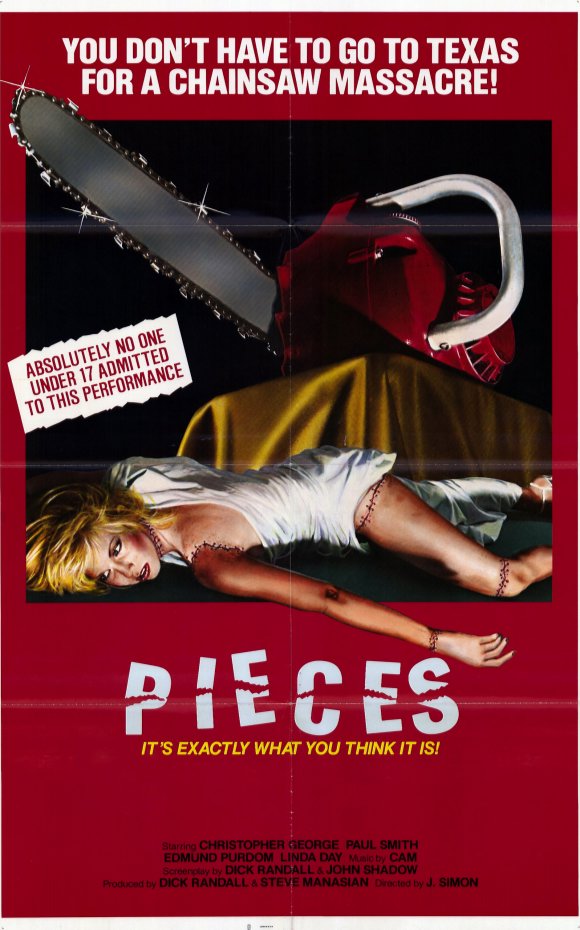
Pieces (1982)


PIECES is one of those rare movies that really does live up to your expectations, not least because everything you have heard from anyone who has seen it is true. It is awful, it is hilarious, it is beyond belief. In fact the only truly unbelievable thing about it is that despite all the insults, accolades and scorn poured on it through the years it really is more than the sum of its parts (sorry). So if the following review of this quite insane picture suggests you might enjoy watching it then be assured that you won’t be disappointed.
‘You don’t have to go to Texas for a chainsaw massacre!’ screams the adline on the free poster I got with the DVD. And you obviously don’t have to be Ed Wood to make something as unintentionally funny and deliriously entertaining as PLAN NINE FROM OUTER SPACE. The film opens in Boston in 1942. We know that because we’re told it by the opening caption, even though this appears to be a somewhat odd version of Boston where jigsaws of very 80s-looking nude ladies are freely available to children like the little boy we then see attempting to assemble said work of softcore naughtiness. Mum isn’t happy when she finds what he’s up to and her admonishment is all that’s needed to send junior over the edge. Grabbing a nearby axe he hacks his mother to pieces in a surprisingly graphic sequence which, if the rest of the film were remotely competent, would actually be genuinely disturbing. Two heavily moustachioed men looking like Spanish supply teachers roped in to be policemen at the annual school play turn up and turn in performances that can only be kindly described as ‘less than adequate’. 
And it’s time for the titles! Pausing only to note that the screenplay was co-written by the man who gave us FOR YOUR HEIGHT ONLY (about a three foot high James Bond-style superspy) and THE EROTIC ADVENTURES OF ROBINSON CRUSOE (no I haven’t seen it but I suspect it’s one of those movies where you can pretty much guess the plot) we can settle down and prepare ourselves for something special.
And goodness me it is. Flash forward forty years and we are on the sort of unnamed American campus where students have sex in the university grounds while  Willard the psychotic gardener (Paul Smith doing his best Jack Elam impersonation by way of Tom Baker from Blackadder) looks on; that is when they’re not getting their heads chainsawed off in broad daylight.
‘The police think it’s an inside job’ says the dean’s secretary, sitting next to the biggest reddest typewriter I have ever seen. The police themselves see it somewhat differently and completely incomprehensibly “We’re just trying on clothes without labels and seeing if they fit” ‘explains’ one officer. Christopher George is in charge of the investigation and he’s even worse.  “I don’t want to wait for the coroner’s opinion” he says to the local anthropology professor (Jack Taylor - Euro horror regular and veteran, or some would say casualty, of hundreds of Jess Franco and Marius Lesoeur produced low budget atrocities),  as he regards the severed body parts of the killer’s latest victim, “I want yours. Could that have been done by a chainsaw like the one covered in blood lying just over there?” Professor Jack has obviously been in these sorts of films before and looks as if he’s considering everything carefully before venturing his opinion, but we know he’s actually wishing he was back at Eurocine rolling around with Lina Romay or Janine Raynaud in some softcore tat.
Suspicion falls for all of two seconds on Kendall James, the nominal hero and school lothario who wears awful check shirts and sky blue cardigans and has a spectacle-wearing best friend he rather unkindly refers to as ‘Goggles’. ‘Goggles’ wear exactly the same kind of clothes as his chum but in negative.
The police are baffled and so decide to do something even more stupid by placing ace tennis pro Mary Riggs ‘undercover’ despite the fact it’s made clear from the first scene that she’s well-known to the public. Meanwhile the killer is slowly completing more bits of that jigsaw we saw at the beginning. Quite often he has a bit of trouble getting the pieces to fit because of the black gloves he’s wearing. Then it’s onto his next actual victim, an aerobics student who finds herself in quite possibly the most hilarious scene of non-suspense ever filmed. She gets into a lift and is followed by our black gloved/coated/hated/masked villain hiding a full size chainsaw behind his back and she doesn’t notice until it’s too late.
Kendall’s fixing his motorbike when he hears her scream, and now so do we, because Kendall has swapped his cardigan for a turtleneck sweater and the kind of anorak Primark would be ashamed to stock. His success with the ladies must presumably lie with his eloquent skills of seduction. But no! A couple of scenes later we see him berating his latest conquest for her slightly vociferous orgasm. “What do you have to make such a big production for?” he says, which is certainly an accusation that can’t be levelled at the filmmakers. This is also the bit where sensitive viewers may have to turn away as Kendall’s full frontal nude scene is by far the most disturbing thing to grace the screen during the movie’s running time. 
Can it get any sillier? Mary is menaced by a professor of kung fu who promptly collapses because of ‘bad chop suey’ and more murders occur. In fact to give the films its due the special effects involved are really very good and within the context of a proper film would have been extremely effective. Unfortunately like a lot of movies from the early eighties the effects are fine, it’s just everything else that’s awful.
Oh but not quite as awful as this film’s ending – a double whammy of quite staggering proportions that I guarantee will leave you unsure as to how to react. 
        Highly recommended in the uncut Region free double disc DVD version from Grindhouse releasing that I watched, just like the trailer says: PIECES – it’s exactly what you think it is. Or at least it should be after you’ve read this.

Thursday, 26 January 2012

To The Devil A Daughter (1976)

Hammer’s final horror picture (at least until the recent revival of the company) kicks off by introducing us straight away to its villain, Father Michael Rayner. We know he’s the villain partly because he’s being excommunicated, secondly because he doesn’t feel one bit sorry for whatever naughtiness he’s been accused of, but mainly because he’s being played by Christopher Lee in a Hammer film that isn’t THE DEVIL RIDES OUT.
A brief title sequence and suddenly it’s twenty years later and we’re in Bavaria where naughty Christopher has somehow become responsible, along with his two German character actor friends, for nun Nastassja Kinski, presumably atoning for her father’s numerous on and off set atrocities over the years. Nastassja gets put on a plane for England where she’s supposed to be met by her sweaty nervous Denholm Elliott of a dad. When she gets there however it's scowly behatted Richard Widmark who gets to take her off to his place for ‘safe keeping’ after being convinced to do so by worried old Denholm at a book signing Widmark seems to exhibit no interest at all in attending, which is odd seeing as it’s his own book that’s being launched.
Widmark is playing John Verney, who is allegedly an expert on the occult, although he appears to be more of an expert in wearing blue herringbone tweed, Gucci loafer slip ons, and looking exceedingly pissed off, all the time. His friends Honor ‘My God did she ever look in the mirror to see what she was wearing?’ Blackman and Anthony ‘At least this is better than my bit part in Tower of Evil’ Valentine are on hand to help (i.e. get murdered) and meanwhile back in Bavaria another German extra is having her legs tied together so her baby can be born unnaturally, following her impregnation by Christopher Lee’s character in a scene where we Most Definitely Do Not Get To See His Actual Bottom.
The baby, which when we get to see it, appears to be the kind of thing that would be more at home in Norman J Warren’s INSEMINOID rather than Nastassja Kinksi’s womb somehow ends up there anyway, or at least it does in a dream sequence. Nastassja and the baby are both needed to bring back Astaroth (I think), a process which requires a hill of flint, a whole woman’s worth of blood, and the complete and utter absence of Richard Widmark holding a rock that he can throw at Christopher Lee’s head. Unfortunately all does not go according to plan and one totally unnecessary and possibly even illegal nude scene later and the film is over. Apparently Dennis wasn’t pleased.

Monday, 23 January 2012

Stagefright (1987) - aka The Owling?

A surprisingly good entry in the 1980s slasher subgenre, STAGEFRIGHT defies expectations by being an Italian horror film produced by Joe D'Amato and written by his frequent collaborator Luigi Montefiore (aka George Eastman / Lew Cooper in this) that's actually well crafted, makes sense, isn't too tastelessly over the top in its portrayal of the murders and has dialogue which sounds as if it's being spoken by actors rather than the usual two or three people crammed into a Soho dubbing suite. One would be tempted to lay all the credit for this endeavour at the door of talented first time director Michele Soavi and certainly his subsequent movies make you sorry he hasn't had a longer career in the horror genre.
              Also known in different territories as DELIRIA and BLOODY BIRD (what would a EuroHorror picture be without several different titles?) the clever opening scene makes us think we're on the hideously cheap set of another Italian horror film. But no - we're actually on the hideously cheap set of an Italian stage play called 'The Night Owl'. After a couple of knowing comments about the Italian horror genre as a whole ("I know it doesn't make sense, but can you imagine the effect on the public?") Alicia (Barbara Cupisti) is off to the nearest hospital with Betty the wardrobe mistress to seek treatment for Alicia's sprained ankle. Unfortunately the nearest hospital is an Institution for the Criminally Insane which also just happens to be looking after psychopathic loony mass murderer plus actor Irving Wallace. Wallace escapes and hides in the back seat of the car (why does no-one ever check there after leaving these places?) before doing Betty in with a pickaxe. After the police have been and gone director Peter (David Brandon, who's not at all bad as the megalomaniacal director, although one wonders if having worked in Italy for some time he may have found quite a bit of inspiration to draw on) decides he's found the hook that will sell his play and locks his actors in for the night. Unfortunately Wallace is in there too and once he's found the owl mask and the keys to the tool and chainsaw cupboard the stage is set (sorry) for a series of well-orchestrated and quite ghastly murders, leading to the now famous scene of all the bits of the victims arranged as a tableau tastefully augmented by swirling feathers amongst which is hidden the key Alicia has to retrieve so she can escape.
                    For a 1980s horror film STAGEFRIGHT hasn't dated too badly at all, possibly because the actors' hair and costumes could conceivably be part of the play they're meant to be appearing in. In the era of SAW and its ilk the murders are still quite horrible and Soavi demonstrates on this picture, as he did on subsequent projects THE CHURCH & DELLAMORTE DELLAMORE, that he's a born director with a natural eye for some impressive visual compositions. As I mentioned above the acting all round seems to be rather better than many EuroHorror efforts (and in particular many Joe D'Amato efforts) and Simon Boswell's electronic music augments the proceedings nicely. I believe there was talk of a STAGEFRIGHT 2 for a couple of years after this one but perhaps it's just as well it never materialised. As it is the movie stands as the best owl-headed theatre set slasher movie out there. Unless of course anyone knows better?

Thursday, 19 January 2012

Kolobos (1999)


A low budget American movie that’s a little bit too ambitious for its own good, KOLOBOS starts with an amateurishly filmed car accident but rapidly gets much better from there. The victim of the accident is teenager Kyra (Amy Weber). Battered and bandaged, she lies in a hospital bed while flashbacks give us her memories of how she ended up there. Discharged from a halfway house for the rehabilitation of patients with mental disorders and with the scars on her arms suggesting a history of self harm, Kyra answers a newspaper advertisement to take part in a low budget backwoods USA film version of Big Brother. Once inside she gets to meet her housemates which include a poor standup comedian, a struggling actress, a college student and a girl who works in a fast food joint. It isn’t long before steel shutters have turned the house into a prison and booby traps are picking them off one by one. But all is not at it seems, and who is the mysterious figure Kyra keeps seeing on the television screen, the one persistently mutilating his own face? 
Starting with a title sequence and music reminiscent of Argento at his SUSPIRIA-like best, there are a lot of nods to that classic in KOLOBOS, including the use of weird coloured lighting filters and everyday objects filmed from unfamiliar angles. Images of figures distorted by frosted glass, hospital curtains and the like abound, and as the film goes on the movie’s deliberate sense of clouded reality increases. It’s nowhere near as stylish as the Argento classic, but directors Daniel Liatowitsch and David Todd Ocvirk obviously have great affection and appreciation for the genre, and even if their bleeding-eyed doctors do get a bit too sub-Fulci at times, it’s in a good way. Oddly enough the movie I was most reminded of while watching KOLOBOS was Norman J Warren’s TERROR, in that it employs much the same Argento-aping style to tell a story that doesn’t really make sense but by the end you don’t really mind because it’s been such a fun ride anyway. Neither director seems to have been at the helm of anything else, which is a shame as the movie should have been a springboard to greater things. KOLOBOS (and I’m not really giving anything away by saying the word translates from the classical Greek for mutilated) is no classic but it’s certainly not hackwork, and is worth 84 minutes of any discerning horror fan’s time.